What people often assume
He wanted the reward.
- Money.
- Status.
- Power.
- The thrill of getting away with it.
Those motives exist. They just do not explain every repetition.
Most people assume punishment should stop repetition. But some loops are not built around wisdom, morality, or future cost. They are built around completion. If the act closes something inside, consequence can lose the race.
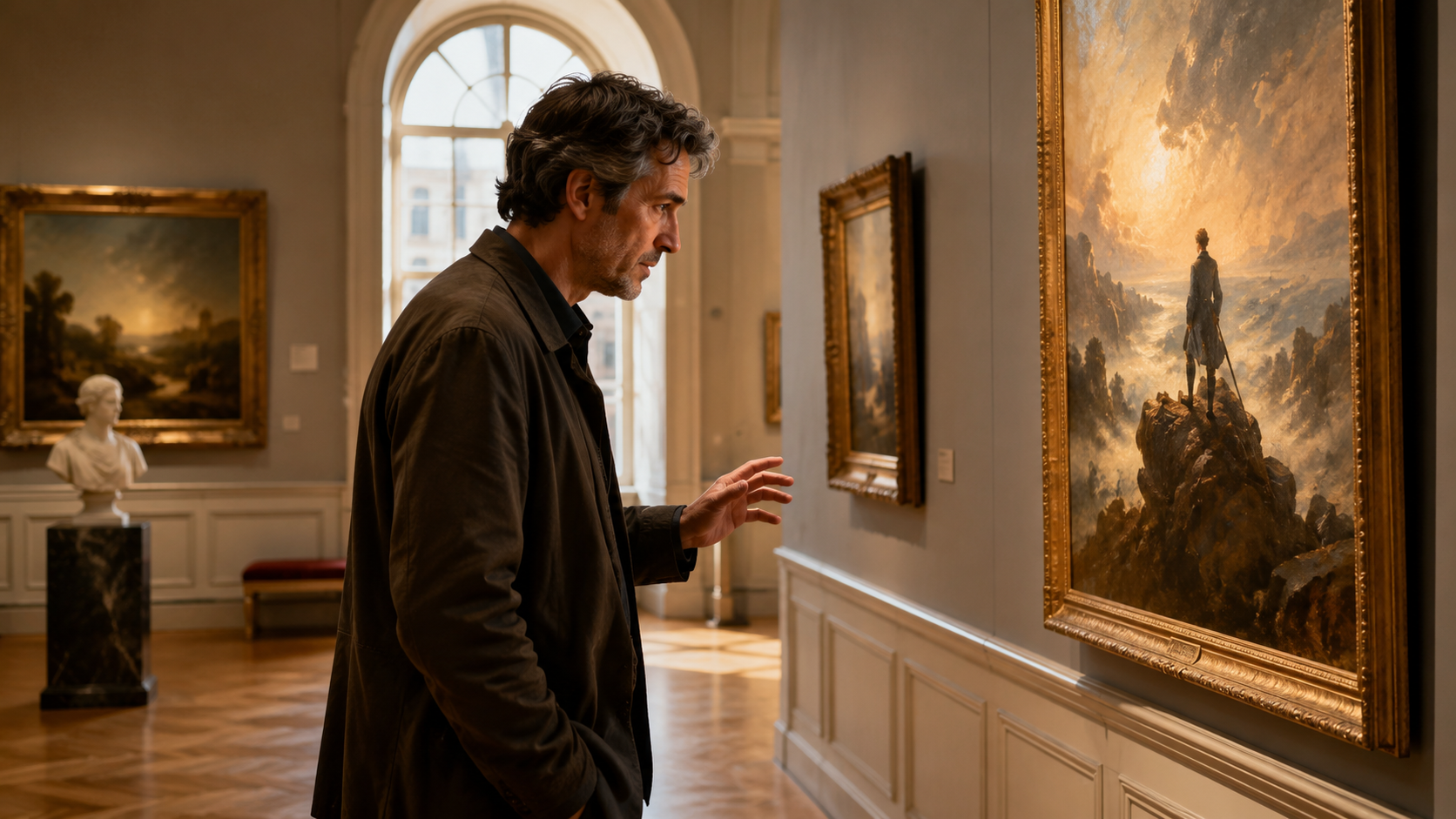
The museum was small enough that footsteps echoed. It was not the Louvre or the Met. It was a provincial gallery—quiet, polite, half-attended. A place where the guards leaned on railings and tourists drifted slowly past landscapes no one would fight over. The paintings were modest by global standards but priceless in the way all art is: irreplaceable once gone.
He did not rush. He studied the room first. The angles. The sightlines. The way the guard’s attention softened when a couple asked a question. He waited for that softness. Then he lifted the painting from the wall, turned, and walked out. No smashed glass. No cinematic chase. Just a quiet act that almost did not register as theft at all.
Over several years, that quiet act repeated itself more than two hundred times. Churches. Regional museums. Private collections. Paintings, sketches, small sculptures—chosen not for resale value, but for something harder to measure. He did not build a criminal network. He did not grow wealthy. He took them home.
His name was Stéphane Breitwieser. Eventually, he was caught. He served time. And then, after prison—after consequence, after interruption, after every reason to stop—he stole again.
If this were mainly about money, the story would be easier to explain. But the works were not sold. They were kept. That is what turns this from a crime story into a circuit question.
This is not meant to excuse the behavior. It is meant to make the mechanism visible.
Two people can do the same thing for completely different neurological reasons. That is why surface behavior can mislead us.
One person steals to sell. The reward is obvious, external, and measurable.
Another may be pulled by the tightening uncertainty before the act and the surge of crossing the line.
Another may be driven by the private satisfaction of having the object close, secured, and kept.
Another may be reinforced by the story: I am the one who can do this. I am the one who takes what others only look at.
Punishment is the architecture of consequence. It can interrupt behavior. But interruption and relearning are not the same thing.
Freedom is removed. Risk becomes real. The cost becomes obvious. The outside world assumes the equation has changed.
If the brain still remembers the route as a powerful way to reach completion, the underlying circuit can remain intact, waiting for access to return.
Most loops never make headlines. But the same larger structure can show up in ordinary habits and private compulsions.
That is what makes this story unsettling. Not only the loss of art, though that loss is immense. It is the glimpse it offers into a system that can value its own closure more than it values freedom.
Once you accept that possibility, the story stops being only about a thief. It becomes a chapter in the larger question this project keeps asking: what happens when a learned route begins outrunning consequence, intention, and explanation?
You are inside an exhibit
Return to the room that brought you here, step beneath the behavior into the shared mechanism, or choose a different doorway.