When Thoughts Won’t Let Go
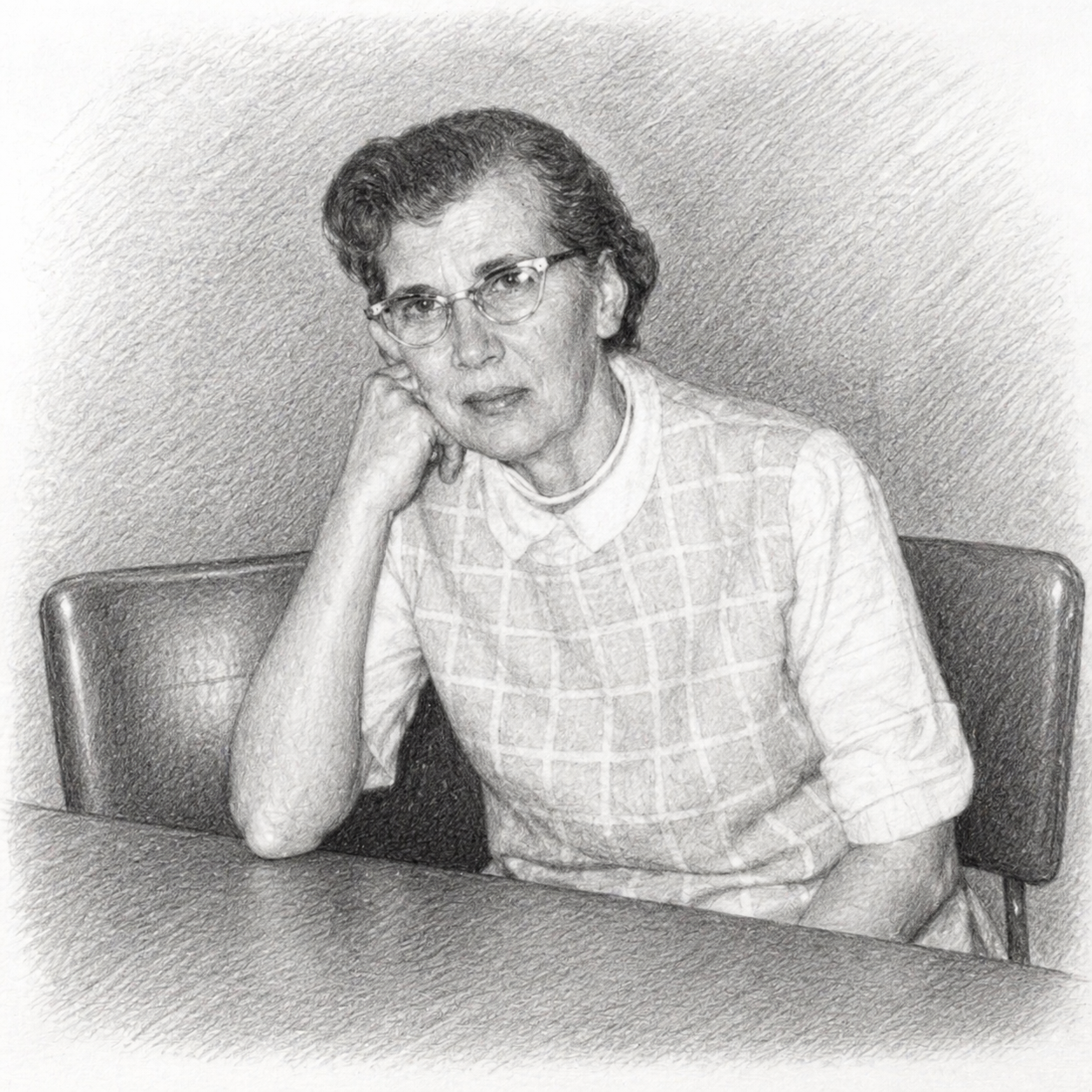
In the photograph, my grandmother is sitting at the kitchen table.
Her elbow rests on the table. Her hand is beneath her chin. Her eyes look forward, but not quite at the camera.
It is a familiar posture to me because I remember seeing it when I was young. I did not have words for it then. I only knew there was a certain look adults got when their minds had gone somewhere the rest of us could not follow.
She looked worried.
Not panicked. Not dramatic. Just held. As if some part of her was listening for trouble before anyone else could hear it.
Money. Family. Politics. The cost of things. The safety of people. The future. The past. The news. The old family stories nobody told all the way through.
I believe she was born near Kiev—Kyiv now, though in our family the old word was Kiev—in a part of the old Russian Empire that later became Soviet Ukraine. The details are blurred at the edges, as childhood family stories often are. But one story stayed with me.
She was moving toward the Romanian border when soldiers fired on the group she was with. In the confusion, she was separated from her family. Lost. Alone.
A Romanian couple traveling in a covered carriage found her and brought her to a Jewish refuge center, where she was eventually reunited with her family. There in Romania, she met the man who would become her husband. From there, they somehow made their way toward America.
That is the story as I remember it.
Not the whole story. Maybe not even the exact story. But enough.
Enough to understand something about the face at the table.
A nervous system raised in that kind of world does not simply relax because the pantry is full.
It learns vigilance.
It learns that danger may arrive without warning. That people can be separated. That safety can disappear in an instant.
It learns that thinking ahead is not merely worry.
It is protection.
Are you sure?
Did you check?
What if something happens?
What did they say?
What does it mean?
The questions are not random. They are loops.
Not because she did not hear the answers. Because the answers did not last.
Repetitive thought often begins as care—as the mind trying to keep something safe by refusing to set it down.
A thought loop begins when the mind finds something it does not know how to release: a hurt, a fear, a memory, a loss, a suspicion, a longing, a question with no clean answer.
The mind returns to it the way the tongue returns to a rough tooth edge. Not because returning is pleasant, but because unfinished things pull attention.
When thought stops moving.
The problem is not that the mind returns once. The turn comes when thought stops producing movement and begins circling.
Thinking moves toward something.
It can produce a decision, a new meaning, a wider view, or a tolerable unanswered question.
Thinking opens the room.
Looping comes back to the same place.
It can feel active and important while returning to the same fear, wound, question, or uncertainty.
Looping makes the room smaller.
Different subjects. A familiar return.
These experiences are not identical. What they share is the mind’s attempt to finish something that still feels open.
Rumination
The mind circles pain, shame, regret, or meaning. The replay is meant to digest the experience, but often refreshes it instead.
Worry
Rehearsal that feels responsible and protective. Love may care; the loop keeps checking.
Grievance
A wound the mind keeps touching while waiting for an apology, a corrected record, or the ending that should have happened.
Suspicion
The mind checks tone, timing, wording, and old memories, trying to turn maybe into certainty.
Grief
The mind returns to the person, the last call, the hospital room, or the ordinary morning before everything changed.
Love obsession
A person becomes a question. Every word is replayed, every delay interpreted, every small warmth used as relief.
Perseveration
The mind has trouble shifting away even after the track is no longer useful. The plain language may be enough: the mind gets stuck.
Co-rumination
Two or more people return together to the same pain, fear, grievance, or uncertainty without widening enough to settle.
Why the mind says: go again.
No brain-area dump is needed. The lived sequence is visible once it is slowed down.
Repetition can make a thought feel more certain without making it more accurate.
This matters most when uncertainty and threat become tightly linked. Not every suspicious thought is paranoia, and not every fearful interpretation is a delusion. But repeated rehearsal can add familiarity and weight to a possibility. Familiarity can begin to feel like proof.
Co-rumination can wear the face of intimacy.
The conversation should have ended twenty minutes ago. The dishes are still on the table. Someone has reached for their keys. Someone else has tried twice to move the room toward something lighter.
“She knew what she was doing.”
No one asks who she is. By now, the whole table knows. A look. A sentence. A text that felt colder than it should have. Another voice joins in: “That’s what I’m saying. It was intentional.”
Now the room is no longer having a conversation. It is circling a wound.
Talking can heal. Being heard can regulate the nervous system. Naming pain can reduce shame.
But two people can also help each other build the case again and again. They may feel seen, joined, and less alone—while becoming more certain, more charged, and more trapped.
The difference is not whether the subject is painful. It is whether the conversation gradually creates more space or keeps refreshing the same emotional charge.
Both can look like “thinking it through.”
The direction of travel is what separates them.
Processing opens the room.
- New meaning can emerge.
- The emotional charge can change.
- Perspective becomes wider.
- The conversation can end with more space.
Looping recycles the charge.
- The same details return with the same force.
- Interpretation grows narrower.
- Certainty may rise without new evidence.
- The mind returns to the same place.
Repetitive thought is human before it is clinical.
Mild for many
Most people replay conversations, worry about someone they love, revisit a loss, or rehearse an uncertain future.
Costly for some
The loop can consume sleep, attention, relationships, work, or the ability to move forward.
Meaning still matters
Grief means you loved. Worry means you care. Grievance means something mattered. Machinery does not erase meaning.
The return is not always proof that the subject remains unsolved.
The thought is not automatically reality. The loop is not automatically wisdom. Sometimes the mind’s return is only proof that the nervous system has been hooked.
This may be worry pretending to be preparation.
This may be grievance pretending to be justice.
This may be longing pretending to be love.
This may be suspicion pretending to be certainty.
This may be a loop.
Recognition is not a cure. It does not create instant peace. But it creates space—and invisible loops run strongest when no space exists around them.