Substance, Risk & Return · Website Exhibit

One More Bet

When uncertainty becomes the hook

From the outside, gambling often looks like a chase for money. But many loops are not only about winning. They are about anticipation, almostness, recovery, and the powerful feeling that the next outcome might settle something unfinished.

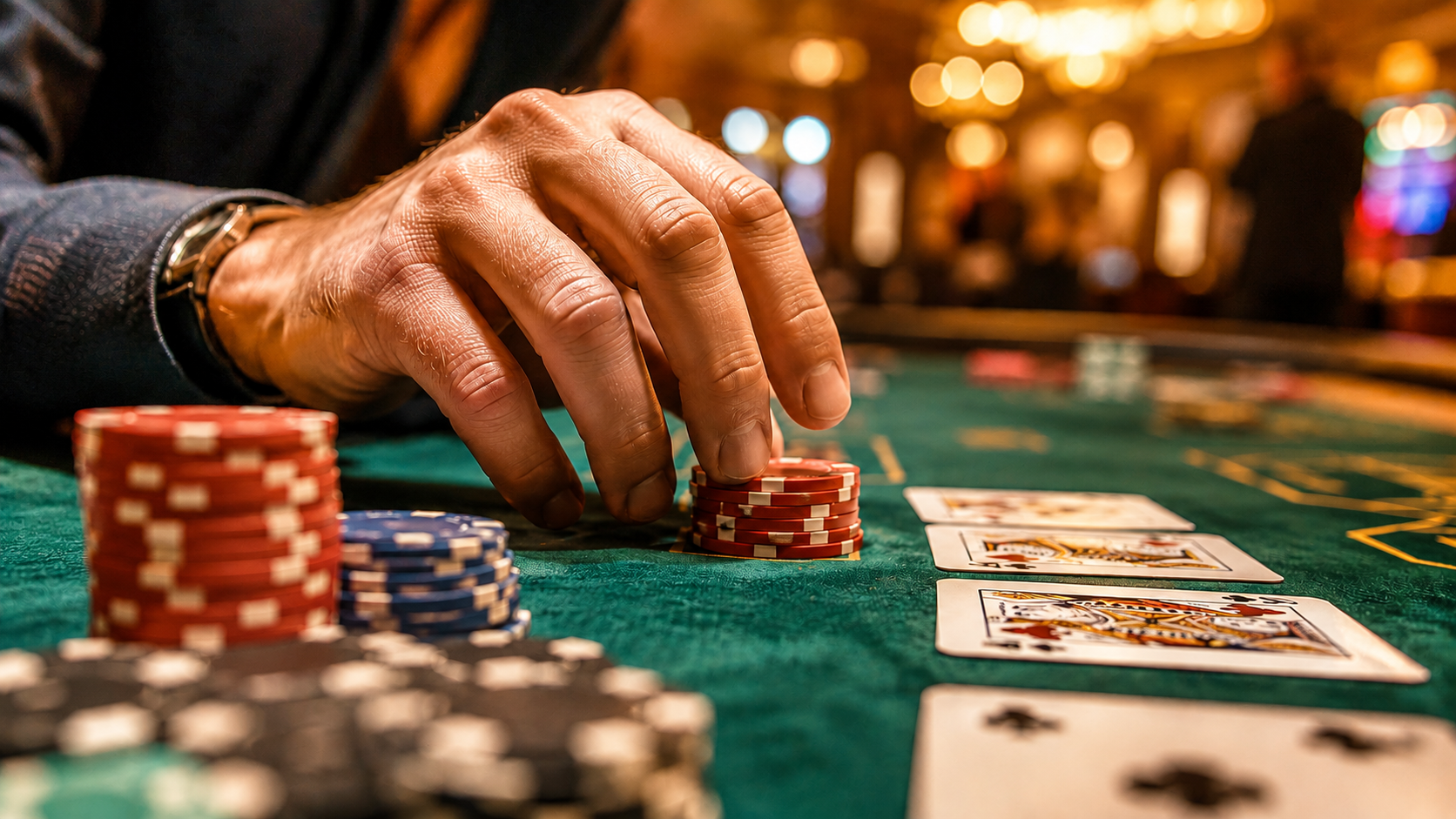
A close-up of a hand placing red chips on a green felt casino table, with cards and stacks of chips in a bright, cinematic casino setting.
It is not just the money on the table. It is the feeling that the next move still matters.

The hand does not slam the chips down. It hovers. That is the moment worth watching. The room is bright, noisy, alive. Cards move. Dealers speak. Lights flicker somewhere behind the felt. But the real drama is smaller than that. It lives in the pause just before the bet lands.

Maybe the last hand lost. Maybe it almost won. Maybe it won just enough to keep the blood warm. Whatever happened, it did not finish the story. Something still feels open. The next bet promises an answer. Not certainty exactly. More like possibility sharpened into a single motion.

That is why gambling can be so sticky. The loop does not end cleanly. Winning can pull you forward. Losing can pull you forward. Even almost winning can pull you forward. The system stays engaged because the outcome always seems just one move away.

From the outside, it can look like a simple question: why not stop? But from the inside, the next bet may feel like the only way to find out how this unfinished moment ends.

The bet is not always chasing profit. Sometimes it is chasing closure.
The part that gets missed

Money matters. But it is not always the whole hook.

In many gambling loops, the pull is not only the reward. It is the state the person enters: narrowed attention, suspended possibility, and the feeling that the next outcome could change everything.

What people often assume

This is about winning.

  • The person wants money.
  • The person likes excitement.
  • The person is making bad decisions.
  • A big loss should end the night.
Those things can be true. They still do not explain why stopping can feel so hard.
What the loop may be doing

This is about an unfinished state.

  • Uncertainty tightens attention.
  • The next outcome feels unusually important.
  • A near miss can feel like proof that the answer is close.
  • The next bet promises resolution: recovery, correction, or completion.
A loop does not ask what is wise over time. It asks what keeps the possibility alive right now.
The sequence on the inside

The visible act is small. The internal sequence is not.

You can see the chips. You cannot see the tightening, the expectation, or the way almostness keeps the route alive.

1 · Something opensA loss, a win, a near miss, or simply a return to the table creates an unfinished feeling.
2 · Attention narrowsThe room fades. The mind locks onto odds, patterns, superstition, or possibility.
3 · The bet landsThe action runs. Chips move. A button is pressed. A card is drawn.
4 · The reveal hitsThe outcome lands with force—win, loss, or almost. Each one can stir the system differently.
5 · The route returnsIf the state remains unfinished, the next bet appears as the most natural continuation.
The outcome matters. But the return loop often lives in what the outcome leaves unfinished.
What makes gambling unique

Uncertainty is not just part of the game. It is part of the reinforcement.

Many loops calm down once the result is known. Gambling can do the opposite. The uncertainty itself can become energizing and hard to walk away from.

Possibility

The next outcome still feels alive. As long as the game continues, the answer has not closed.

Near miss

Almost can be more activating than nothing. It can feel like the system was close enough that stopping now would be premature.

Recovery

After a loss, the next bet can present itself as repair: one more chance to get back to even, to undo the damage, to finish the story differently.

Rhythm

The repeated cycle—bet, reveal, react, return—can become its own engine, even before large wins or losses appear.

The next bet does not arrive from nowhere. It arrives from a system already leaning forward.
Why stopping is not simple

Winning can reinforce. Losing can reinforce. Almost can reinforce.

That is why gambling loops can be so confusing from the outside. Different outcomes can all feed the return in different ways.

If you win

The system learns: this was worth doing. The route feels validated.

If you lose

The system can insist: the story is not over. One more chance could restore what was just lost.

If you almost win

The system may hear: you were close. Keep going. The answer feels near.

Different outcomes. Same problem: the loop still has a reason to continue.
Spectrum and de-shame

Same basic circuitry. Different volume.

For some people, gambling remains entertainment. For others, it becomes a high-volume loop that can outrun judgment, money, and consequence.

Mild for many

The person plays, enjoys the uncertainty, and can leave when the evening ends or the limit is reached.

Damaging for some

The return starts getting louder. The next bet begins to feel unusually important. Losses are harder to tolerate, and stopping gets harder.

Consuming for others

The loop narrows around correction, recovery, or completion. Money, promises, and consequences begin losing ground to the return.

The kinder frame: the point is not to excuse damage. It is to understand the structure. The same engine that can make a game exciting can, at higher volume, turn uncertainty into a trap. Seeing that clearly lowers shame and makes the loop more legible.
Why this exhibit belongs here

“One more” is not a slogan. It is a state.

That is what gambling adds to this room. The return is not only to a substance or a behavior. It is to a living possibility. The loop says the answer is still in play. The unfinishedness stays on the table.

Once you see that, gambling starts to sit beside the other exhibits more clearly. The first cigarette, the second drink, the risky act, the return to relief—they are not identical behaviors. But they all show a system leaning toward the next move because the current state does not yet feel closed.

Sometimes the hook is not the reward. It is the unresolved possibility of reward.