Draft museum exhibit build · Hair Pulling / Trichotillomania
Exhibit path
Doorways → Body-Focused Habits → Hair Pulling
Body-focused repetitive behavior

Hair Pulling

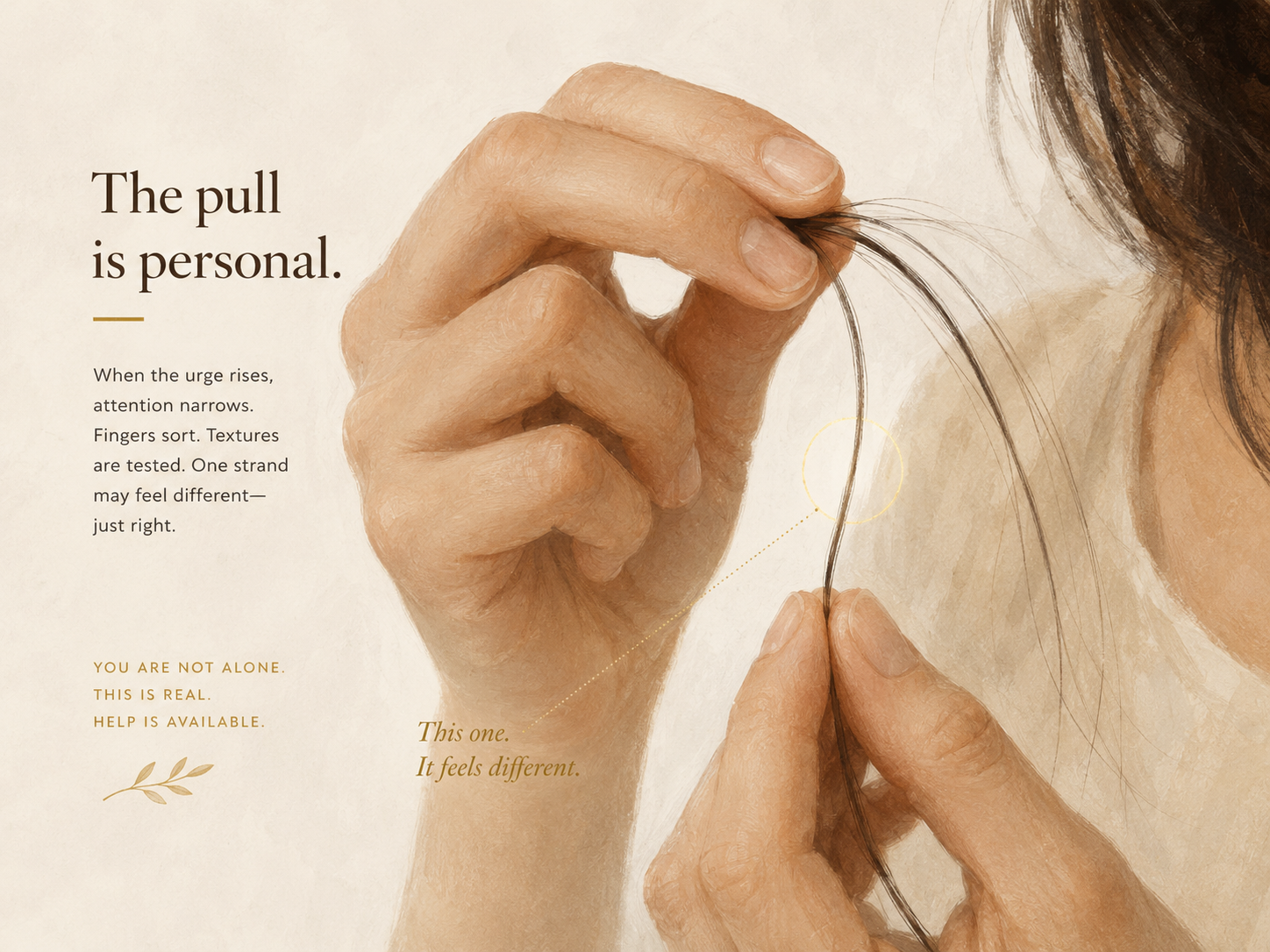
Also called trichotillomania when it becomes clinically significant, hair pulling often begins with a quiet sensory search: fingers sort, textures are tested, and one strand starts to feel different from the rest.

This exhibit treats the behavior as real and recognizable. It does not collapse it into “just a habit,” vanity, or lack of control. It looks at how texture, selection, relief, and repetition can come together.

An illustrated close-up of hands sorting and holding strands of hair, highlighting one strand that feels different.
Recognition scene

The strand that feels different.

For some people the hand rises while reading or watching television. For others the movement is focused and intentional. Either way, the fingers often know what they are looking for before words do.

The book is open. The show is on. The conversation is still going.

Meanwhile, one hand has drifted upward. The fingers separate a small section of hair and begin sorting strands one by one.

Most are passed over. Then one feels coarser, kinked, wiry, thicker, bent, or simply more noticeable than the others.

This one. It feels different.

The attention narrows. The strand is rolled, tested, and held. Then comes the pull. A tiny sting. A brief release. Sometimes the person sees the hair afterward and only then realizes the sequence has completed itself again.

Clinical language, without shame

When hair pulling becomes a disorder.

Hair touching, twirling, and occasional pulling are common human behaviors. This room becomes clinical only when the pattern becomes repetitive, difficult to control, and meaningfully disruptive.

Trichotillomania

In clinical language, recurrent hair pulling that leads to noticeable hair loss and causes distress or impairment is called trichotillomania.

It belongs to the body-focused repetitive behavior family and sits within the obsessive-compulsive and related disorders spectrum.

Naming it does not reduce a person to a label. It says clearly that the experience is recognized, studied, and worthy of compassion.

What clinicians look for

  • Recurrent pulling that causes hair loss or thinning
  • Repeated attempts to decrease or stop
  • Distress, concealment, time loss, or impairment
  • Pulling from scalp, eyebrows, eyelashes, beard, or other body hair
  • Not better explained only by another condition or grooming practice

Many people live near the doorway. For some, the volume turns up and the route becomes hard to interrupt.

Simple mechanism display

How the loop keeps returning.

Strand noticed → fingers sort → texture tested → one hair selected → pull and release. The relief can reinforce the search, so the hand learns to look for the next “different” strand.

1

Strand noticed

One section of hair begins to stand out. Sometimes the person is scanning deliberately. Sometimes the fingers find the spot before awareness catches up.

What the nervous system is trying to finish

The person is often searching for a strand that feels just different enough.

The target is not always visible. Often it is sensory: too coarse, too bent, too thick, too rough, or simply not matching the rest.

The just-right strand

Hair pulling often carries a feeling of precision. The fingers do not treat every strand equally. They search, compare, and isolate.

The loop can be chasing a match between touch and relief.

That helps explain why the behavior may continue even when the person sincerely wants to stop. The system keeps believing the next strand may be the one that resolves the signal.

Why the search comes back

After the pull there may be a brief drop: release, satisfaction, completion, quiet, or reset. The nervous system saves that route.

Later, the fingers return and begin searching again. A different body area may become the next site, but the job can stay the same.

That is the loop: the brief relief after one pull can keep teaching the hand to look for the next hair that feels different.

Family connections

Different target. Similar sensory logic.

Across the body-focused family, the object changes — skin, hair, cuticle, nail, lip — but the nervous system may still be trying to resolve a small sensory mismatch.

Skin picking

A surface irregularity becomes hard to leave unfinished, and the attempt to fix it creates the next cue.

Resolve the spot
Nail biting

A rough edge on the nail or cuticle recruits the mouth the way a rough strand recruits the fingers.

Smooth the mismatch
Eyebrow or eyelash pulling

The site changes, but the search for one hair that feels “off” may stay familiar.

Remove the different one
Beard or body-hair pulling

The selected strand may be coarser, sharper, more bent, or easier to find by touch.

Find the coarse strand
Hair twirling or splitting

For some people, the hand sorts and manipulates texture without always ending in a pull.

Test the texture
Different volume

The same circuitry can whisper or insist.

Move the control to see how the lived experience changes. This is a spectrum, not a verdict.

Loop volume

The strand does not have to become objectively more different. The signal simply becomes harder to ignore and easier for the hand to follow.

Mild and occasional for many. Distressing and impairing for some. Same basic circuitry, different volume.
How commanding is the search for that strand?
2
Noticeable: the hand returns while reading, watching television, working, driving, or using the phone.
Signals and leverage

Several kinds of leverage may matter.

This is not a coaching list. It is a way of understanding why different changes may help different parts of the loop.

1

Understanding

Naming the loop can reduce shame and explain why the behavior feels precise rather than random.

2

Sensory context

Texture, idle hands, mirrors, focused attention, fatigue, and quiet concentration can all alter how noticeable the target strand becomes.

3

Access and protection

Hair length, coverings, alternate hand activities, and reducing the ease of search can change how quickly the route gets launched.

4

Circuit pressure

Sleep, stress, arousal, stimulation, and chemistry can change how commanding the search feels before the fingers begin sorting.

Chemistry and circuit pressure: Brain chemistry can influence how compelling the search-and-pull sequence feels and how strongly the loop is rehearsed. This exhibit leaves the chemistry unnamed and points forward to the Glutamate and Volume Knob galleries, where that mechanism is explored alongside sensory context, understanding, and protection.
Forward paths

Keep following the signal.

Hair pulling expands the Body-Focused wing beyond edges and surfaces. Here the target is often not a visible flaw but a felt difference — a strand that stands out under the fingers and seems to ask for action.

Read the manuscript pathway

The Reading Room holds the broader book context for body-focused repetitive behaviors. This exhibit translates that framework into a specific sensory sequence.

Open the Reading Room