Working Preview V64N9
The completed Body-Focused Habits wing

Body-Focused Habits

Skin, hair, nails, lips, and hands can become the surface where a nervous system searches for smoothness, release, certainty, or completion.

The surface changes. The nervous-system job often does not. This room brings four finished exhibits together without treating every repeated movement as a disorder.

What holds this wing together

The target changes. The loop can rhyme.

Something is noticed. A precise movement follows. The sensation changes. For a moment, the system settles. Then the route becomes easier to run again.

Something noticed→ precise movement→ sensory change→ brief completion→ return
Clinical spectrum

BFRB is a family term.

Body-focused repetitive behaviors include patterns involving skin, hair, nails, lips, cheeks, and related body sites. Some are mild and occasional. Excoriation disorder and trichotillomania are recognized clinical disorders when the behavior causes damage, distress, or impairment.

This room is for recognition and understanding. It is not a self-diagnosis tool.
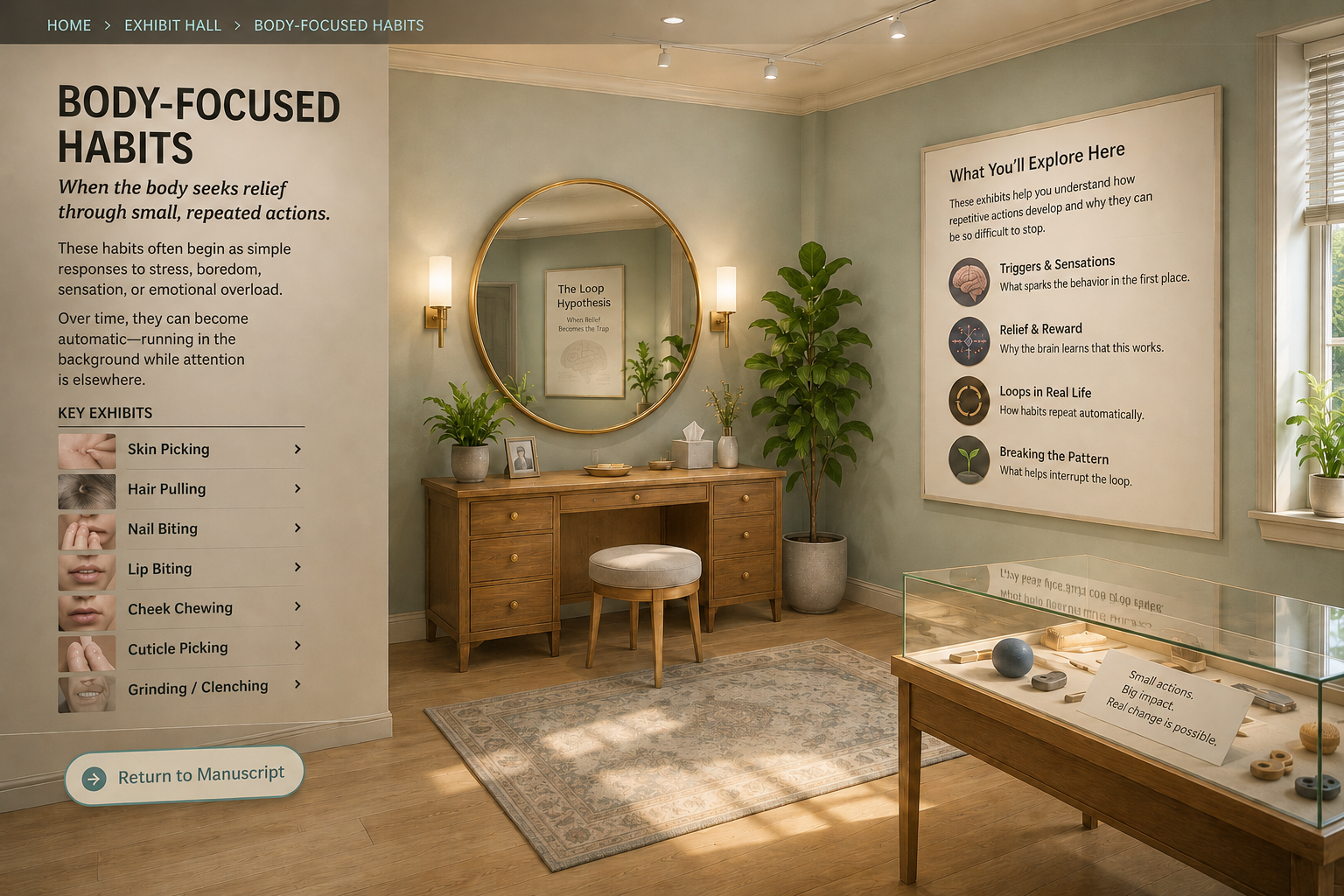
Choose one of the completed exhibits below. Each opens a different surface of the same larger body-focused family.
Completed exhibit map

Four ways the body can carry the loop.

Enter through the behavior that feels most familiar.

Body-Focused Habits Wing

Smaller pathways still ahead

Cuticle PickingSmall borders that become loud.
Eyebrow & Eyelash PullingRelated pulling routes with their own visibility and concealment concerns.
Other Body-Focused LoopsAdditional patterns that may overlap with skin, hair, mouth, and sensory regulation.
Where this doorway enters the manuscript

Body-Focused and Edge Loops

This doorway connects to the manuscript pathways on nail biting, skin picking, hair pulling, cuticles, mouth overlap, edge signals, and hidden hands.