Working Preview V64N3 — Second Complete Museum Exhibit
Complete museum exhibit · Oral edge loops

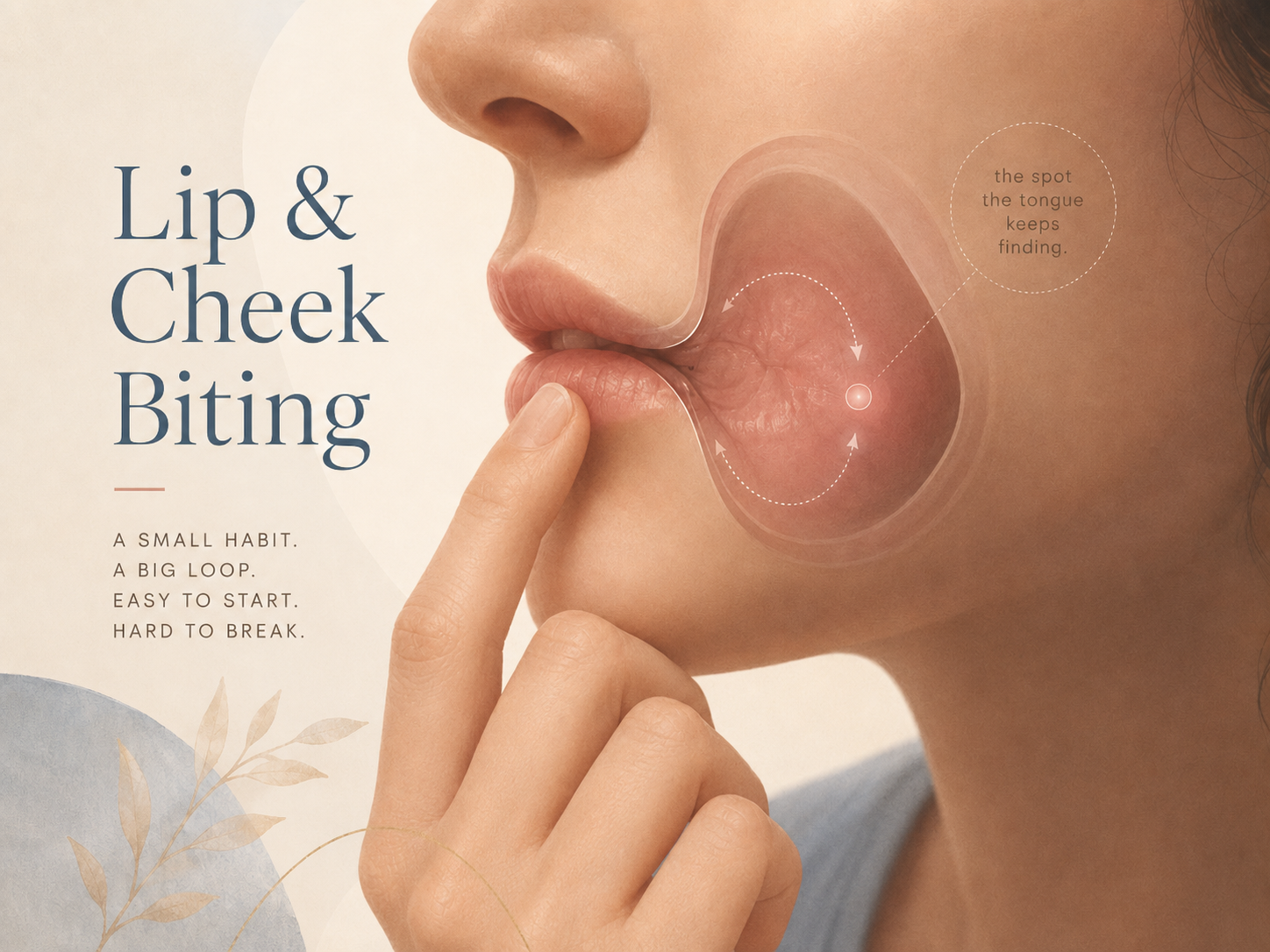
Lip & Cheek Biting

The tongue finds the spot first. The teeth return before awareness fully arrives.

A tiny rough place inside the mouth can become both the target and the product of the loop trying to fix it.

Editorial illustration showing a finger touching the lips with a highlighted inner-cheek spot, representing lip and cheek biting loops.
Recognition scene

The work continues. So does the mouth.

He is reading carefully, following an idea that needs his full attention.

His tongue moves across the inside of his cheek and finds a small raised place. It may have begun as nothing more than a tender ridge. Now it feels unfinished.

The jaw shifts. The teeth catch the spot. A small bite changes the texture.

For a moment: different, quieter, done.

Then the tongue checks again. The bite has made the place rougher. The roughness becomes the next signal. Only later does he notice the soreness and wonder how long the movement had been running.

The mouth did not set out to injure itself. It was trying to finish a sensation.

Walk through the mechanism

How one small spot becomes a repeating route.

Select each station. The loop can begin with sensation, move into autopilot, and manufacture the cue that calls it back.

1

Spot noticed

A ridge, swollen place, dry patch, or tiny mismatch appears inside the mouth. In a high-definition sensory zone, a very small texture can feel unusually important.

What the nervous system is trying to finish

The target is not the tissue. It is the unfinished signal.

The person is usually trying to make one tiny place feel even, smooth, settled, or complete.

The mouth as scanner and tool

The tongue detects tiny changes in texture. The teeth can alter them instantly. Together they create a fast sensory-motor route.

The mouth is not chasing pain. It is chasing a clean ending.

That is why the movement can be precise, repetitive, and hard to explain as ordinary choice.

When repair creates the next problem

A bite may briefly flatten or change the spot. But it can also create swelling, tenderness, or a new rough edge.

The tongue returns to inspect the result. The new texture becomes the next cue.

That is the loop: the attempted fix keeps manufacturing the reason to fix again.

Family connections

Different surface. Similar completion logic.

Lip and cheek biting sit where oral loops, body-focused habits, and edge loops overlap.

Nail biting

A rough outside edge recruits the mouth to create smoothness.

Resolve the boundary
Cuticle picking

A raised border becomes difficult to leave alone.

Make it even
Tooth checking

The tongue returns to a ridge, filling, or contact point.

Confirm the surface
Scab picking

A healing edge feels unfinished, and the correction renews it.

Seek closure
Jaw clenching

The same mouth may shift from edge-seeking into pressure and rhythm.

Regulate the system
Different volume

The same loop can be occasional or consuming.

Move the control to see how the lived experience changes. This is a spectrum, not a diagnosis.

Loop volume

The spot does not become more important. The signal becomes harder to leave unfinished.

Mild and occasional for many. Damaging and difficult to interrupt for some. Same basic circuitry, different volume.
How commanding does the spot feel?
2
Noticeable: the tongue keeps finding the same place during focus, driving, reading, or quiet transitions.
Signals and leverage

Different approaches act on different parts of the system.

This is a mechanism map, not a set of instructions.

1

Understanding

Naming the pattern as a sensory-motor loop lowers shame and changes the meaning of the urge.

2

Sensory input

A retainer, oral substitute, pressure change, or competing signal may temporarily redirect what the mouth is organizing around.

3

The physical surface

Dental edges, bite contact, dry tissue, swelling, and repeated injury can all shape the cue the tongue keeps finding.

4

Circuit pressure

Focus, fatigue, privacy, stress, stimulation, sleep, and chemistry can change how easily the old motor route is selected.

Chemistry and circuit pressure: Brain chemistry can influence how easily an old sensory-motor route is selected and how urgent it feels once it begins. This exhibit leaves the chemistry unnamed and points forward to the Glutamate and Volume Knob galleries for the deeper explanation.
Forward paths

Follow the loop from surface to signal.

Lip and cheek biting connect the mouth, the body, edge detection, sensory gating, and the chemistry that changes loop volume.

Read the manuscript pathway

The Reading Room places lip and cheek biting within the broader Oral Habit Loops and Body-Focused Repetitive Behaviors chapters. This exhibit turns that material into a walk-through mechanism.

Open the Reading Room